Showing posts with label Tolkien. Show all posts

March 25, 2010

The Salvation of the World

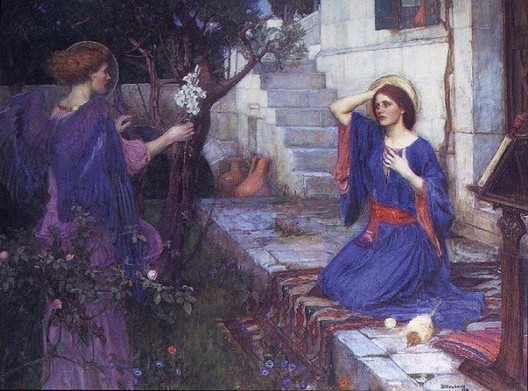
Today is a day I look forward to for two reasons, (don't you, too?)  First, today is The Feast of the Annunciation - the day when the Angel Gabriel came to a young girl named Mary and asked her to be the Mother of Our Lord, thus setting in motion the final steps to the salvation of the world.

The second reason is another celebration... a fictional one, I will admit, but a celebration non the less.  For today in Lord of the Rings history is the day that Sauron's Ring was destroyed, thus bringing about the salvation of Middle Earth.

As a devout Catholic and an avid Lord of the Rings fan, I am always overjoyed at how well these two loves go together.  Tolkien was a devout Catholic and this is very evident in his works.  But I'm sure you know that already, so I'll just cut to the quick and share with you some beautiful Catholic analogies (note, I said analogies, not allegories) and 'co-incidences' that I and my fellow Tolkien-fanatic friends have uncovered.

The Beginning of a New Year
This morning my dear friend, whom I shall call 'Flora Gamgee' gave me a call, first to wish me a Happy Annunciation, and secondly to bid me a Happy Destruction of the Ring Day.  During the course of our conversation, she told me that she just found out that in the traditional Catholic calendar, the liturgical year began today - March 25th, the Feast of the Annunciation.  Appropriate, since the Annunciation is when God's plan for our salvation was set in to play.
Now, Tolkien would have known about this fact and so I find it of great and exciting interest that he picked March 25th as the day the Ring would be destroyed.  From that day forth "in Gondor the New Year will always now begin upon the twenty-fifth of March when Sauron fell." - Return of the King

The Seven Sacraments
Back in January, I spent the night at another Tolkien-friends house and spent at least an hour and forty-five minutes discussing the Lord of the Rings.  (Oh, heaven!)  We could have talked longer... but decided that as it was about two in the morning we probably get at least some sleep - given the fact that we had to get up early the next... er, that morning.
"Well, I expect that I shall go on sleeping, whether I drop off or no.  And the less said the sooner I'll drop off, if you get my meaning." - Samwise Gamgee
The prevalent theme of our discussion was the analogies contained in the Lord of the Rings.  We are firm believers that there are no direct allegories, because Tolkien said so himself that he detested allegories.  However, I do believe and contend that there are many analogies - how could there not be, with such a devoted Catholic as the author? 
One of the allegories we discussed were the presence of the Seven Sacraments.  To tell the truth, we only found six, but we are sure the seventh is hiding in there somewhere.

Baptism
"Frodo heard the splash of water.  It foamed about his feet.  He felt the quick heave and surge as the horse left the river... He was across the Ford. ... 'By Elbereth and Luthien the Fair', said Frodo with a last effort, lifting up his sword, ' you shall have neither the Ring nor me!' ... the black horses were filled with madness, and leaping forward in terror they bore their riders into the rushing flood.  Their piercing cries were drowned in the roaring of the river as it carried them away." - The Fellowship of the Ring
  
For those who are not familiar with the Catholic Sacrament of Baptism, the candidate renounces Satan and all his evil works, is immersed in or has the water poured over his head and the black stains of Original Sin are washed away, in much the same way that Frodo rides through the river, tells the servants of Sauron to go away and the Black Riders being swept away by the flood.  (There are other actions involved - such as the anointing with oil and lighting the baptismal candle, but as they do not directly pertain to the analogy I am trying to demonstrate, I did not mention them.)


Confession 
"Aragorn knelt beside him.  Boromir opened his eyes and strove to speak.  At last slow words came. 'I tried to take the Ring from Frodo,' he said.  'I am sorry.  I have paid.'" - The Two Towers
 
This analogy is not quite as obvious in the books, but has a beautiful representation in the movies, particularly when Aragorn makes an almost Sign of the Cross-like gesture and blesses Boromir. (I am sure the filmmakers were quite unaware of any similarities.  But that makes it all the cooler!)  Boromir is dying after having tried to take the Ring from Frodo, and then defending Merry and Pippin from the orcs.  Aragorn finds him, and Boromir confesses to him what he has done.  As Aragorn consoles him, telling him that he is forgiven, Boromir dies.

Holy Communion
"Often in their hearts they thanked the Lady of Lórien for the gift of lembas, for they could eat of it and find new strength even as they ran." - The Two Towers
"The lembas had a virtue without which they would long ago have lain down to die.... it fed the will, and it gave strength to endure, and to master sinew and limb beyond the measure of mortal kind." - The Return of the King

As much has already been written on the similarities of the lembas bread and the Eucharist - it being the more obvious of the analogies -  I will not add my own interpretation here.  I will only say... wow.  Is that last quote amazing or what?

Confirmation
"'We have drunk the cup of parting," she said, 'and the shadows fall between us.  But before you go, I have brought in my ship gifts which the Lord and Lady of the Galadhrim now offer you in memory of Lothlorien.'" - The Fellowship of the Ring

This is another of the more hidden ones, but it is no less beautiful for it being hidden.  While Galadriel is not like a Bishop, or the Holy Spirit, she most certainly was inspired to give her gifts to the Fellowship.  Nine gifts, gifts that would strengthen and help each bearer in one way or another in their struggle against the evil of Sauron.

Matrimony
"And Aragorn the King Elessar wedded Arwen Undomiel in the City of the Kings upon the day of Midsummer, and the tale of their long waiting and labours was come to fulfillment."
And so it was settled.  Sam Gamgee married Rose Cotton in the Spring of 1420 (which was also famous for its weddings), and they came and lived at Bag End." - The Return of the King


I don't think I need to explain this one very much, do I? ;)  As we all know, Aragorn and Arwen, Faramir and Eowyn and Sam and Rosie were all married and all had long and beautiful lives together.

Holy Orders
Now I must confess that this is the Sacrament we are stumped on.  We are quite sure there is an analogy somewhere, but have not quite found it yet.  Any help?
Perhaps though... we are looking at this the wrong way... Read the later section titled "A Priest and a Deacon" and then give me your thoughts on the matter.

Anointing of the Sick
"So at last Faramir and Eowyn and Meriadoc were laid in beds in the Houses of Healing; and there they were tended well.
'The hands of the king are the hands of a healer.'" - The Return of the King

The Houses of Healing were a place in the city of Minas Tirith where those who were ill or dying were brought to be healed.  Many could be cured by ordinary means, but some required the special touch of the King.  It reminds me of how we often fall ill, but sometimes we need this sacrament, the healing of the King, to help us through our illness.  The beauty of it is that the Anointing of the Sick (formerly called 'The Last Rites') provides spiritual healing as well - just as Faramir and Eowyn were also healed of spiritual ailments in the Houses. 

A Priest and A Deacon
I cannot take credit for discovering either of the following analogies, having been informed myself by my friend Flora Gamgee and the other friend I mentioned who does not have a name.  Hmmm... I need to tell her to fix that.
While at the sleepover with my nameless friend, she mentioned that in ways Frodo was like a priest and Sam like a deacon.  Frodo had his specific task he was given, just as the priest has his.  Sam, as with the deacon, could not do Frodo's task for him - but he could help him to accomplish it.  Also, in case you never noticed, Frodo does not get married, just as a priest cannot, while Sam does.  (It is permissible for a deacon to be married, though technically they have to get married before they become a deacon.  Which is why these are analogies, not allegories.)

Finally, something that Flora pointed out to me that I found quite fascinating.  Before Frodo and Sam start their journey up Mount Doom (which has been likened to Christ's journey up Calvary) they eat the last bit of their food, they have their Last Supper.  As Frodo journey's up the mountain, bowed down with the weight of his burden, he stumbles and falls until at last he can go no further.  Then Sam helps by picking up Frodo and carrying him until he has the strength to go on.  (Simon of Cyrene, anyone?)

At that point the similarities stop, as Frodo gives in to the Ring's power.  But that is only natural.  Frodo was human - er, hobbit - and was able to give into temptation.  As I said before, that's why these are analogies and not allegories.  While some might discredit the imperfect fit of what I have just outlined, to me the fact that these incidents are not perfect fits, are not allegorical makes them that much more beautiful and fascinating.

So one these two special days - one Catholic, the other fictional - I hope I have given you something to ponder and marvel at the beauty of God's creation.  Thank you for bearing with me in my very long post.  =)

Nai haryuvalyë melwa rë!
(May you have a lovely day)
~ Silmarien

December 16, 2009

If You Don't Want the Lord of the Rings to be Ruined Forever, Don't Read Past This Point.

When Tolkien created the Ringwraiths, I don't think he expected that one day there would be Ringwraith fangirls. But there are! I mean honestly, wraiths are so awesome!

I suppose that it is all my friend Lanta's fault... after all, she's the one who started it by falling in love with and marrying the Witch King of Angmar. Then again... I had created this awesome, adorable and sarcastic Ringwraith named Soyousay before then. So we get equal blame. ;)

Well our love of Ringwraiths has reached new proportions. I am quite positive that Tolkien turned over in his grave last night during a certain conversation I had with Lanta. We had gotten the idea to name all the wraiths before, but last night we actually did it.

Now, we decided that the wraiths have two names, their evily cool elvish-y names and their code names. How are these code names determined? By their most common phrase that they say! (Like Soyousay quite regularly responds with "So YOU say!")

Oh, you also need to know that The Witch King is actually two people, Cor (Lanta's husband) and Cor's evil twin brother. So there are actually ten Ringwraiths because Sauron told them to share the ring. (That's a really long story. I'll tell it some other time.)

Anyhow, so between Lanta and myself, and myself and my sisters, all ten Nazgul now have code names! They are pretty indicative of their personalities. It's hilarious

Shutup = Cor's evil brother
Whatnow = Cor
Soyousay = my wraith and BF
Sowhat = Soyousay's younger brother
Yeahright = Sowhat and Soyousay's uncle
Whatever = random wraith at this point
Whocares = ditto
Ofcoursenot = ditto
Offine = ditto
Tim = the spoiled ten yr. old brat

Yes, you read that right, Tim (actually, he would say "It's 'im!" but everyone always thought he was saying "Tim".)

Anyhow, after Sauron gave out the first 8 rings, he was looking around for the last king to give the ring to. He went all over the place, but no one would take it! No one! Finally Sauron stumbled across this little kingdom, ruled by this bratty ten year old king. Why Sauron didn't give the ring to the regent, I have no idea, but he was fed up with searching and gave it to Tim, who took it gladly.

Note: The reason you don't see any short Ringwraith's in the movies is because the rest all forced Tim to wear these stilts, since a short wraith is hardly terrifying.


And there you have it. I intend to write a story about how they all became wraiths at some point. It shall be quite fun! The Tolkien purists will all kill me.

But who cares?

September 24, 2009

September 24th

As part of my studies, I am reading about the history of the elves in the Encyclopedia of Arda. Today my studies are on the Teleri, to whom I belong. I have copied down part of the selection in my journal, as a handwriting exercise. I will have perfect handwriting that Gandalf can't critique!

A name for the Teleri, the third of the three clans of the Elves that made the Great Journey from Cuiviénen. This clan of the Elves was 'third' in that it was the last of the three to set out on the Journey. This tardiness was no doubt in part due to the size of the clan: it had a far greater populace than either the Vanyar or the Noldor, and it took two lords, the brothers Elwë and Olwë, to organise its people.

As well as being slower on the road than the other clans, groups of the Teleri fell away from the main Journey more than once. This happened most famously in the area later known as the Vales of Anduin, where an Elf named Lenwë led away a great part of the clan to found the people known as the Nandor.

The people of the Third Clan travelled so slowly that by the time they had crossed Beleriand and reached its western coasts, the Vanyar and the Noldor had already gone ahead across the Great Sea. While his people waited in Middle-earth, Elwë became lost, and many of his people set about searching for him. Others became pupils of the Maia Ossë, and decided to settle on the coasts of Beleriand. So, when Ulmo returned across the Great Sea years later to transport the Teleri to Aman, many of them remained behind. Most important of these were the followers of Elwë, the people who would become known as the Sindar.

Meanwhile the remainder of the Third Clan - a far smaller group than had originally set out from Cuiviénen - remained for a long time on the Isle of Eressëa in the Bay of Eldamar. They were taught ship-building by Ossë, and led by Olwë they sailed across the Bay to reach the shores of Aman at last.


March 25, 2009

The Realm of Sauron is Ended

But the Nazgul turned and fled, and vanished into Mordor’s shadows, hearing a sudden terrible call out of the Dark Tower; and even at that moment all the hosts of Mordor trembled, doubt clutched their hearts, their laughter failed, their hands shook and their limbs were loosed. The Power that drove them on and filled them with hate and fury was wavering, its will was removed from them; and now looking in the eyes of their enemies they saw a deadly light and were afraid.


Then all the Captains of the West cried aloud, for their hearts were filled with a new hope in the midst of darkness. Out from the beleaguered hills knights of Gondor, Riders of Rohan, Dúnedain of the North, close-serried companies, drove against their wavering foes, piercing the press with the thrust of bitter spears. But Gandalf lifted up his arms and called once more in a clear voice:


“Stand, Men of the West! Stand and wait! This is the hour of doom.”


And even as he spoke the earth rocked beneath their feet. Then rising swiftly up, far above the Towers of the Black Gate, high above the mountains, a vast soaring darkness sprang into the sky, flickering with fire. The earth groaned and quaked. The Towers of the Teeth swayed, tottered, and fell down; the mighty rampart crumbled; the Black Gate was hurled in ruin; and from far away, now dim, now growing, now mounting to the clouds, there came a drumming rumble, a roar, a long echoing roll of ruinous noise.


“The realm of Sauron is ended!” said Gandalf. “The Ring-bearer has fulfilled his Quest.” And as the Captains gazed south to the Land of Mordor, it seemed to them that, black against the pall of cloud, there rose a huge shape of shadow, impenetrable, lightning-crowned, filling all the sky. Enormous it reared above the world, and stretched out towards them a vast threatening hand, terrible but impotent: for even as it leaned over them, a great wind took it, and it was all blown away and passed; then a hush fell.


When I first read through the Lord of the Rings, I was glad for the included dates (Bilbo and Frodo's birthday on Sept. 22nd, the Fellowship setting out Dec. 25th, etc.) because it gave a sense that the events really happened, and here are the dates they were on. I could celebrate and look forward to each date.

It wasn't until maybe a year or so after my first read of the Lord of the Rings that I began realizing the significance of some of the dates that Tolkien picked. For example, the day that the ring was destroyed, March 25th. I don't recall exactly which biography or book about Tolkien that I read this in, but I read that Tolkien picked March 25th, because there is an old Norse legend that the 25th of March was the date of the Resurrection of Christ. I thought this was pretty neat, and given that I knew that Tolkien was a devout Catholic, his choice of this date didn't surprise me and I never really thought that much more about it, until this morning.

I've been reading and following the blog "Moments of Grace" (formerly "The Road Through Middle-Earth") since Anne Marie started writing it and her writings have caused me to start looking at the works of Tolkien in a different, more spiritual way. (By the way, if you haven't visited her blog at all, you've been missing out on some wonderful meditations!) So naturally with this new mindset, when I realized that the Destruction of the Ring and the Feast of the Annunciation were on the same day, I began thinking of ways that the two events might be similar. (I did, and maybe I'll get to those later.)

It popped into my head this morning at Mass and I realized something extraordinary. Christ began His mission of saving us from sin and death with His birth on Christmas Day, the same day that the Fellowship set out on their mission of saving Middle-Earth from the Dark Lord Sauron. Christ died on Good Friday, begging the end of His mission, and completed it on Easter Sunday, rising from the grave and defeating death and sin for all eternity. The ring was destroyed on "Easter Sunday", defeating Sauron forever, freeing Middle-Earth from darkness and death.

When I realized that, something else clicked as well. A while back I'd figured out that from the middle of "The Fellowship of the Ring" when the Fellowship sets out from Rivendell, to near the end of "The Return of the King" when the ring is destroyed, only three months have passed by, which seemed really strange to me, considering how much action occurred in those three months! But when I looked at it from the perspective of the journey starting on Christmas and ending on Easter, that short time span made sense, it fit.

Thank you Anne Marie, for helping me to discover this! And a Happy End-of-the-Reign-of-Sauron-Memorial-Day to you all!

Sing now, ye people of the Tower of Anor,
for the Realm of Sauron is ended for ever,
and the Dark Tower is thrown down.

Sing and rejoice, ye people of the Tower of Guard,
for your watch hath not been in vain,
and the Black Gate is broken, and your King hath passed through,
and he is victorious.

Sing and be glad, all ye children of the West,
for your King shall come again,
and he shall dwell among you all the days of your life.

And the Tree that was withered shall be renewed,
and he shall plant it in the high places,
and the City shall be blessed.

Sing all ye people!

December 15, 2008

"I Will Take the Ring" - The Fiat of Frodo

Anne Marie, from The Road Through Middle-Earth, again graciously allowed me to reprint another one of her moving, thought provoking and wonderfully Catholic posts. I encourage you all to follow her blog and read her posts - which really are meditations - whether or not you are a fan of the Lord of the Rings. Since it is rather a lengthy post, I have only put part of it on my blog and included a link to the rest, which can be found on Anne Marie's blog. Please read and enjoy!

"We are God’s work of art, created in Christ Jesus to do good works, which God prepared in advance for us to do" (Eph. 2:10).

Frodo could have said no when the Secret Fire, the Holy Spirit, presented him his vocation. All he had to do was remain silent. The Voice was heard within his own heart and soul. He could have remained still. The Virgin Mary could have said no at the Annunciation. She was alone when the angel visited her. But God had prepared His children well and had molded their souls in such a way all their lives for this one moment, though they knew it not. It was their humility that allowed them to submit themselves to the Will of a Power which in Frodo’s case, he doesn’t even know. His heart and soul recognized their Maker, though, and said yes.

God knows our answer even before we do, but He gives us the free will to choose that answer. "...what you are to say will be given to you when the times comes; because it is not you who will be speaking; the Spirit of your Father will be speaking in you" (Mt 10:19-20). Frodo felt very much like "some other will was using his small voice", but it was still his choice to let that other Will speak through him. God has such respect for that that He doesn’t force us to do anything even though He knows it would benefit us and/or others. He allows for abortion and abuse and all sorts of hatred and violence because in the end, even our evil choices, though we may thwart Him in one turn, He will still bring good out of them in another way. He asks for our free consent to His good Will, but He doesn’t coerce us as the Ring bludgeoned Frodo when it could no longer seduce him.

It takes great courage and sacrifice to say yes aloud when we are screaming no inside, to totally surrender ourselves to Someone else, to give up control and say "I am yours; do with me as You will." But it is in that crucible that we discover ourselves to be who we truly are meant to be: the person God has already seen us becoming if we say yes, the one He has loved from all eternity. He knows that we are weak, but He deliberately chooses the weak so His Power can shine through all the more clearly. He has no use for the self-proclaimed strong of the world. Frodo is among the myriad others who would have much rather not been chosen since they did not felt equal to the task God was asking of them. But He Who had fashioned them and knew them better than they knew themselves, knew they were equal, not on their own strength, but on the strength that He would provide with His grace. Both could have said no, indeed Cardinal Ratzinger before he became Pope Benedict XVI begged God not to choose him, as Jesus had prayed to be spared His agony, but both hobbit and man submitted and surrendered their own wills to God’s Will, as did Jesus. Like Mary would say millennia later at the Annunciation, they said, "Fiat" - "Let it be done."

In speaking of this and the choices that confront us all, Cheryl Forbes said in an article for Christianity Today, "We choose to be chosen."(12/19/75, p. 12). The choice Frodo made at the Council, he made again and again with every breath and step he took toward Mordor. Mary said it many times, even at the Cross, watching her Son die in agony. Surrender is not a one-time event that does not need to be repeated, but an ongoing, continuous one that has to be embraced every day, every moment. Under the coercive pressure of the Ring, Frodo said no several times along the way and at the end, as we all do at times, but he said yes many, many more times and we must also.

"I will take the Ring, though I do not know the way." As Peter Kreeft says, these are the "sacramental, operative words that set in motion the only power that can conquer Sauron..." ("Wartime Wisdom: Ten Uncommon Insights About Evil in The Lord of the Rings" in Celebrating Middle-earth, p. 39).

Though Frodo’s heart quails to contemplate the terrible journey before him, he still accepts that it has been "ordained" and "appointed" that he walk the dark Road that is ahead. We are not placed when and where we are by accident. There is a plan and purpose for everything. We may not see it at once or maybe not even until we pass from this life, but there is a reason all happens as it does. God has an intent for all of us and we must be ready when He calls us. We have been given experiences, been molded and shaped a particular way, given specific interests and abilities, set in a particular place and time, along specific roads just so we are where we need to be at the time we need to be. We have the freedom to say no also to all this careful, deliberate planning, such is God’s gift to us, but if we say no, then we will not be performing what we were made to do. "[I]f you do not find a way, no one will," Elrond tells Frodo after Frodo has embraced his vocation. God has created us for a particular purpose and if we don’t do it then that job may not get done, that part of the Song not heard. St. Padre Pio once had a vision of a woman’s son when she came to the priest for confession. He grew greatly agitated and told the woman he had seen her son. When she denied having one, he told her... Read the rest here

November 4, 2008

One Ring to Rule Them All

This is a blog post written by a beautiful young Catholic lady on the blog "The Road Through Middle-Earth". Her blog is devoted to the works of Tolkien, which she is reading through and then commenting on the chapters and events from the books on her blogs. I have been following it ardently, and enjoy reading her wonderful... meditations. Her writing have made me look at the Hobbit and the Fellowship (the only ones she has been writing about so far) in a entirely new and wonderful way. She has graciously given me permission to re-publish this post that she wrote when she began reading the Fellowship of the Ring. Please take the time to read it, and then why don't you check out the rest of her blog as well?

The tone is quickly changing and will become ever darker, but illuminated with many moments of grace that will come fast and furious at times. There are lighter moments still though. I think of Frodo, standing there under the stars, so very beautiful, lit by his own self-contained moonlight and what a wonderful marvel that would have been to behold. Here we are also introduced to Sam's love of Elves.

The meat of the chapter though is Gandalf's catechism lesson to Frodo about the Ring and about pity. The orc attack drove Bilbo into the tunnels just in time to find the Ring is termed in the Prologue to this tale to be seemingly an "accident" and the finding of the Ring to be "mere luck". But there are no "accidents" in God’s plans. Everything and everyone is carefully placed, even those who are not aware they have been. Free will is not interfered with, but used to God’s greater glory as the Great Music continues to play out. Hearts are fashioned so they will respond freely in the fashion God knows from all time that they will. When the Ring leaves Gollum, in response to its master’s call, God makes sure Bilbo is there to put down his hand in the dark and find it. He does not stop the call from being sent out from Sauron, but once more, he sends a hobbit to ‘intercept’ that call as He had with Déagol & Sméagol. It was not Bilbo’s choice to find the Ring, nor was it was the choice of the Ring to find Bilbo. The frightened hobbit had no idea what it was or what value it had. It was just a pretty little thing and he found it useful. He was not aware that he was an instrument of the One. Only much after the fact does Gandalf, Frodo and the rest of us learn how fateful that journey in the dark truly was. When Bilbo stays his hand from slaying Gollum, he does not know that he is laying some very important groundwork for the destruction of the Ring, the future salvation of his beloved nephew and heir, as yet unborn, and, indeed, helping to determine the fate of the entire of Middle-earth. He sees in Gollum the pitiable, horrifying condition of one enslaved to sin and realizes in some dim way, that "there but for the grace of God, go I". Because Bilbo extended that pity, Frodo is later able to learn from it when he takes his own journey and extends it himself to Gollum and even more importantly, Sam learns from Frodo to do it, as Faramir had done earlier. When Frodo first meets Gollum, he sees in the wretched, twisted creature the same thing his beloved uncle had: a reflection of who he could become, just as he reflects Bilbo in pity. Another step is taken toward the destruction of the Ring. He has gone from "What a pity that Bilbo did not stab that vile creature" to "For now that I see him, I do pity him."

The very fact that Bilbo adopted Frodo as his heir is a moment of grace. Even tragedies have their place in the making of who we are and what we are meant to do. If Frodo’s parents hadn’t drowned, then there would have been no need for Bilbo to adopt him and make him his heir, and eventually heir to the Ring; no living so very close to Sam; no setting down roots in the fertile soil of that humble gardener’s loving heart; no blossoming of that beautiful relationship which is so vital to the Quest that it would have failed without it. It is no coincidence that Sam was born the same year Drogo and Primula were drowned. One sees how each piece fits together in the story. How many threads going back decades did God weave into the destruction of the Ring; how many things He guided to happen just at the right time. It is quite amazing actually. Such threads run through our lives also. It is entirely possible that Frodo and Sam would have still met had Frodo’s parents’ lived on to a ripe old age and Bilbo still made him his heir upon leaving for Rivendell, but God chose the way and events He did, for a reason and though we may not understand it all ourselves when tragedies interrupt our lives and lead us off in directions we wouldn’t have otherwise traveled, we have the comfort that God has allowed everything for a reason and ultimately that good will come of it. We just need to have faith and trust that He loves us far more deeply than we can imagine and wills nothing but what will help us come to Him in His heavenly Home which is the home He wishes for us also.

After discovering that Bilbo lied about how he come by the Ring, Gandalf tells Frodo, "I might perhaps have consulted Saruman the White, but something always held me back." There is no time that God is not actively involved in His children’s lives. At the time, Gandalf does not know what prudence held him back from revealing his knowledge of the Ring’s whereabouts, nor did he know that Bilbo’s ring was the Ring, but he trusts in that "still, small voice" that he heard in his heart.

At Gandalf’s behest, Aragorn sought long and hard for Gollum, but in vain and finally on his way home, as he tells the Council of Elrond, "...by fortune, I came suddenly on what I sought: the marks of soft feet beside a muddy pool." Each step is being guided here. We need never to doubt or think that God is not actively, personally involved in our lives. If we are open to His purposes for us, He will guide and guard on the way and reveal bit by bit what we are to do. We need only to surrender ourselves into His Hands, as Aragorn and Gandalf spent a lifetime doing, as Frodo offered himself up to do, though at first he struggles with his vocation and his fear of it.

How many times since he asked "Why was I chosen?" have others echoed him down through the ages with the same protest as he that they were not "made for perilous quests" and have "so little" of heart, wits and courage needed for such grand and dangerous things? Jeremiah, Isaiah, Gideon all protested in one way or another, not understanding at first the call, thinking themselves too young (Jr 4-8), unclean (Is 6:5), too weak (Gideon, Jg 6:12-16). But they all still said in the end: "Here I am, send me" (Is 6:8). They all said as Jesus did during his Agony in the Garden, "Nevertheless, let Your will be done, not mine." (Lk 22:43). They accept they have been chosen and submit themselves to that. Frodo does not realize Who chose him, but he fully acknowledges that he has been chosen, so he is aware, in whatever dim way, there is a Chooser above him Who has selected him. We have been chosen too, each one of us, and the more we surrender control over ourselves to God, the more wonders He can and will work in our lives and we will discover our own unique vocations.

When he is first told of the Ring, Frodo, however, doesn’t want to get involved. He most definitely wants the Ring to be destroyed, the danger to be removed, but he doesn’t want to be the one to do it. It’s very frightening to realize that it’s up to us sometimes to be that instrument of God’s Will to destroy the evil that has sprung up in our time. No wonder he wishes, as we have all at times, "I wish it need not have happening in my time." Moses resisted his call at first. Jonah fled and had to be swallowed by a whale before he accepted his. It is natural for us to resist what seems to be impossible or incredibly dangerous. We don’t like to leave our comfortable lives. Frodo longed for adventures, even for a dragon to come by and shake things up a bit, but he wanted a happy adventure in which he could return happy and whole at the end of it. Destroying the Ring was quite a bit outside his comfort level. Still he learns as we do at times that we may seek adventure, but Quests seek us. By ourselves we can do nothing; with God we can do everything. We can still be broken by our task, but we can be healed by the same One who laid the Cross upon our shoulders and will help us carry it if we let Him. It is not evil that comes from God’s Hand, but love, even when it’s in the form of the Cross, perhaps even especially then: "The Everlasting God has in His wisdom foreseen from eternity the cross He now presents to you as a gift from His inmost Heart," says the great Bishop, spiritual director and Doctor of the Church, St. Francis de Sales (1567-1622). "This cross He now sends you He has considered with His all-knowing eyes, understood with His divine mind, tested with His wise justice, warmed with His loving arms and weighed with His own Hands, to see that it be not one inch too large and not one ounce too heavy for you. He has blessed it with His Holy Name, anointed it with His grace, perfumed it with His consolation, taken one last glance at you and your courage, and then sent it to you from heaven, a special greeting from God to you, an alms of the all-merciful love of God."But He does not ask us to carry our Cross alone. God understands how weak our wills are, how easily we are overcome at times. That is why He sets others at our sides, for there is strength in numbers and when one is weak, the others can be strong and strengthen the one who is faltering. That is why Sam and all the others, and in the end, Sam and Sméagol alone, were placed at Frodo’s side, for he had the greatest burden. "Better two than one by himself, since thus their work is really profitable. If one should fall, the other helps him up; but woe to the man by himself with no one to help him up when he falls down. Again: they keep warm who sleep two together, but how can a man keep warm alone? Where one alone would be overcome, two will put up resistance; and a threefold cord is not quickly broken"(Eccl 4:12). There is no way any one person could have destroyed the Ring. Frodo had many invisible guardians also. We are not alone in our struggles, even if we feel that we are. Jesus had Simon of Cyrene, Frodo had Sam. The saints and martyrs have had others encouraging and strengthening them, even at times Jesus Himself or His Mother. Time and time ago it is shown that "Frodo wouldn’t have got far without Sam" and a third being was needed for the final victory. When we are terrified to accept the burden that we fear will crush our fragile spirits, we should realize from Whose loving Hand it comes from and when we are bowed under the weight and our strength is failing, there will be others to help and God will not abandon us ever. "Do not look forward in fear to the changes of life," counsels St. Francis de Sales. "Rather look to them with full hope that as they arise, God, whose very own you are, will lead you safely through all things;and when you cannot stand it, God will carry you in His arms. Do not look forward to what may happen tomorrow. The same Everlasting Father who takes care of you today, will take care of you today, and every day. He will either shield you from suffering or will give you unfailing strength to bear it. Be at peace, then, and put aside all anxious thoughts and imaginations."

Sometimes we need to pass through the fire to be tested and there we will find the strength we didn’t know we had. Frodo thought he had "so little" of heart, wisdom and courage but God knew he had a great store of it, as all hobbits do in a crisis. He let the Quest play out as it did so Frodo would know what Frodo was capable of. So He will let our Quests play out so we can discover our strengths. With His help, we will not be found wanting. He will not give us a task that beyond us. He knows what our true strength is and will give us enough grace to accomplish it if we cooperate with Him. Frodo did not fail. He succeeded brilliantly when anyone else would have failed. He was never meant to be Ring-destroyer, since God knew that would be beyond his strength, beyond anyone but Himself. He was present there at the Fire as He had been all along to save Frodo and all Middle-earth when His beloved child’s mortal flesh, will and strength collapsed under the terrible power of the demonic. We are not alone. It is sometimes in the darkness that we can best see the light. Even Jesus was terrified of his coming trials, so God perfectly understands that we feel we are not up to our tribulations or what we fear could be terrible. He knows how our heart quails. But Jesus went on, Frodo went on, the martyrs went on. We need to go on. We are guided and guarded the whole way and though the path may indeed become very dark, the Light will always be there with us, though at times we may not perceive it. Things will be much easier for ourselves if we surrender to Him and let Him work through us. "I know God will not give me anything I can’t handle. I just wish He didn’t trust me so much," Blessed Mother Teresa said who walked through decades of darkness, faithfully serving her God, though for His own good purposes, He chose to hide His face from her, so she could be a shining example to others of perseverance amidst the terrible night. Frodo is another who has inspired many to walk through their own dark nights. They have all shown by their actions that wisdom of Gandalf's words: "All we have to decide is what to do with the time that is given us."

Even after Gandalf tells him of the dangers of the Ring, how it will "possess" and "devour" its bearers and will cause him to fade or become invisible permanently if he uses too often and how he would then walk "in the twilight under the eye of the dark power that rules the Rings", Frodo agrees to guard the Ring "whatever it may do to me." He is terrified by Gandalf’s words, but because he doesn’t want anyone else to be harmed by it, he is willing to take that harm himself and try to contain it within himself if he can. At this point he doesn’t truly understand what those words will come to mean to him, what the terrible cost will be, or that he will be asked to bear the Ring much longer than "for the present" which is all his original plan was until someone better, wiser and stronger than he could take it. But he and everyone else will learn that there is no one else better. Once Frodo accepts his vocation, he embraces it fearfully but over time completely. He’s willing to, even expecting to, sacrifice his life. Even before he leaves the Shire, he doesn’t expect to return. Though he does physically, he cannot completely mentally or emotionally. He is not the same person. He sacrificed everything for the Quest. In that crucible of suffering, everything was burned away, including his identity as a happy, innocent, carefree hobbit. He is stripped down to naked will and endurance and clothed in grace. It is that innocence and that grace which enabled him to be the Ring-bearer. Though he hopes at first to be able to leave the Ring at Rivendell and be done with it, he still steps forward and volunteers to take the Ring to Mordor to destroy it, and this when he’s even more aware of its powers and has already almost died bearing it. We may all think we are unequal to a task looming before us, but God will suffuse us with the strength and grace to accomplish it if we are open to accepting it. Frodo was. He succeeded perfectly as Ring-bearer, which is what he was created to do. He was not created to be Ring-destroyer. That was Gollum’s task.

Another lesson that will later bear fruit in Frodo's heart is that he hears Gandalf speak of the small hope for Gollum’s redemption that later enables Frodo’s own hope and efforts for a "cure" for Sméagol. That pity and the lessons learned from the painful presence of the Ring will also in its time extend to Saruman. Gandalf and Galadriel also attempt to convince Saruman to repent, but no avail. Frodo doesn’t want Saruman killed, even after the murderous attack on him at Bag End because even though the cure is beyond them, the Ring-bearer hopes it can be found elsewhere and it won’t be if Saruman is killed. These three recognize that a fallen soul must be given opportunities to redeem itself and they are responsible to extend the offer, though, it’s up to the fallen whether to act upon or not. That Saruman and Sméagol are both unable to come back, the former because of pride, arrogance and hatred, and the latter because his will was not strong enough, is not the fault of those who made the attempt. Frodo, Gandalf and Galadriel are being their "brother’s keeper". It would count toward their credit at judgement that they stretched forth the possibility of redemption. Even though Gandalf considers it, in Saruman’s case, to be "dangerous, and probably useless," he also says "it must be done". It was their responsibility to try while there was hope left as it our responsibility to fraternally correct our erring brethren. Even after nearly 500 years as Ring-bearer, there was still a little Sméagol left in Gollum and that is no small wonder. That is why we should not give up trying to help and praying for the cure of those held in the chains of the Enemy. We can always return when we’ve strayed, though the further into our fall, the harder it will be to rise and return. But "while there’s life, there’s hope" as Sam says, quoting his Gaffer. We will learn in heaven all the good we did. Perhaps someone was saved only through our prayers who would have been lost otherwise, who somehow found the strength to fight their way back to God, out of the darkness into the light.

Gandalf renounces the Ring at Bag End when both Bilbo and Frodo unwittingly tempt him with it because he doesn’t trust himself not to use it if it was in his possession. He is glad when he returns from death that the "deadly peril" of the Ring is no longer something he or anyone else can be tempted to use. Even as Gandalf the White he fears it, perhaps even more so, because his power is greater. Good and strong as he is, he knows he is also weak and that is where his true wisdom and strength lies. It is the wisdom and strength Saruman, his superior, had already abandoned, though no one knows that yet.

Frodo's already growing attachment that will grow to addiction to the Ring is shown here as well.

I love the powerful images also that are here. To name just two, Frodo closing his fist around the Ring to hide it from the dark hand he imagines reaching out to grasp it and him imagining the Fire itself while looking into his own small fire and seeing such great darkness and then coming 'back' to Bag End and being surprised that all is still actually light. He does have a tremendous imagination, doesn't he, quite right for a scribe and lover of tales to have. I wonder if part of his torment though was the Ring taking advantage of that and showing him terrible visions as it consumed him more and more until there was nothing left but itself. It would have done that no matter what but perhaps it would have tormented Frodo more because he had such a lively imagination.

September 22, 2008

HAPPY BIRTHDAY FRODO AND BILBO!!!!!


Many, many thanks to the Society of Avid Young Readers, who reminded me of this most important event!

Bilbo and Frodo Bagginses Birthday!!!!

And now, for what is probably the most famous birthday speech in history!
(this is just what Bilbo said, not the whole commentary in between. If you want that, read the book.)

My dear people,
My dear Bagginses and Boffins, and my dear Tooks and Brandybucks, and Grubbs, and Chubbs, and Burowses, and Hornblowers, and Blogers, Bracegirdles, Goodbodies, Brockhouses and Proudfoots! [Proudfeet! ;) ]
Proudfoots. Also my good Sackville-Bagginses that I welcome back at last to Bag End. Today is my one hundred and eleventh birthda: I am eleventy-one today! I hope you are all enjoying yourselves as much as I am. [Yes! =) ]
I shall not keep you for long. I have called you all together for a Purpose. Indeed, for Three Purposes! First of all, to tell you that I am immensely fond of you all, and that eleventy-one years is too short a time to live omong such excellent and admirable hobbits. I don't know half of you half as well as I should like, and I like less than half of you half as well as you deserve!
Secondly, to celebrate my birthday. I should say: OUR birthday. For it is, of course, also the birthday of my heir and nephew, Frodo! He comes of age and into his inheritence today. Together we score one hundred and fourty-four. Your numbers were chosen to fit this remarkable total: One Gross, if I may use the expression.
["No cheers. This was ridiculous." I love those two sentances!]
It is also, if I may be allowed to refer to ancient history, the anniversary of my arrival by barrel at Esgaroth on the Long Lake; though the fact that it was my birthday slipped my memory on that occasion. I was only fifty-one then, and birthdays did not seem so important. The banquet was very splendind, however, though I had a bad cold at the time, I remember, and could only say "thag you very buch". I now repeat it more correctly" Thank you very much for coming to my little party".
Thirdly and finally, I wish to make an ANNOUNCEMENT. I regret to announce that - though, as I said, eleventy-one years is far too short a time to spend among you - this is the END. I am going. I am leaving NOW. GOOD-BYE!

The Tolkien Reading Quest

As Lady Merilwen, I thought I'd take a moment to let y'all know about The Tolkien Reading Quest, a quest and a blog set up by Aladwen. She proposes what may be for some a daunting task... none less then a challenge to read through Tolkien's works on Middle-Earth. ALL of them! In her words,
No less have I required of myself to be able to say that I have a "comprehensive Tolkien education!" I've always been a Lord of the Rings buff, but have put off reading most of JRRT.'s posthumous works (other than The Silmarillion) because I wanted to re-read The Trilogy first. So, I decided to have a blog marathon and read as much as I can in order to gain the coveted title of "Tolkien Scholar!"
So who of you brave of heart out there would like to join in? Ride your nobel steeds over to her blog to see the schedule of events and if you are willing, pledge to join the challenge! We start today with The Hobbit.

Let us set off into the wondrous realms of Middle-Earth!

November 17, 2007

Quote on the Eucharist


Out of the darkness of my life, so much frustrated, I place before you the one great thing to love on earth: The Blessed Sacrament... There you will find romance, glory, honor, fidelity and the true way of all your loves upon earth, and more than that: Death: by the divine paradox, that which ends life, and demands the complete surrender of all, and yet by the taste of which alone can what you seek in your earthly relationships be maintained, or take on the complexity of reality, or eternal endurance, which every man's heart desires.
~ J.R.R. Tolkien in a letter to his son.